The Kelpie
A horse walks out of the loch at dusk, black and dripping, weed tangled in its mane. It stands very still and lets you come close. That is the whole trick.
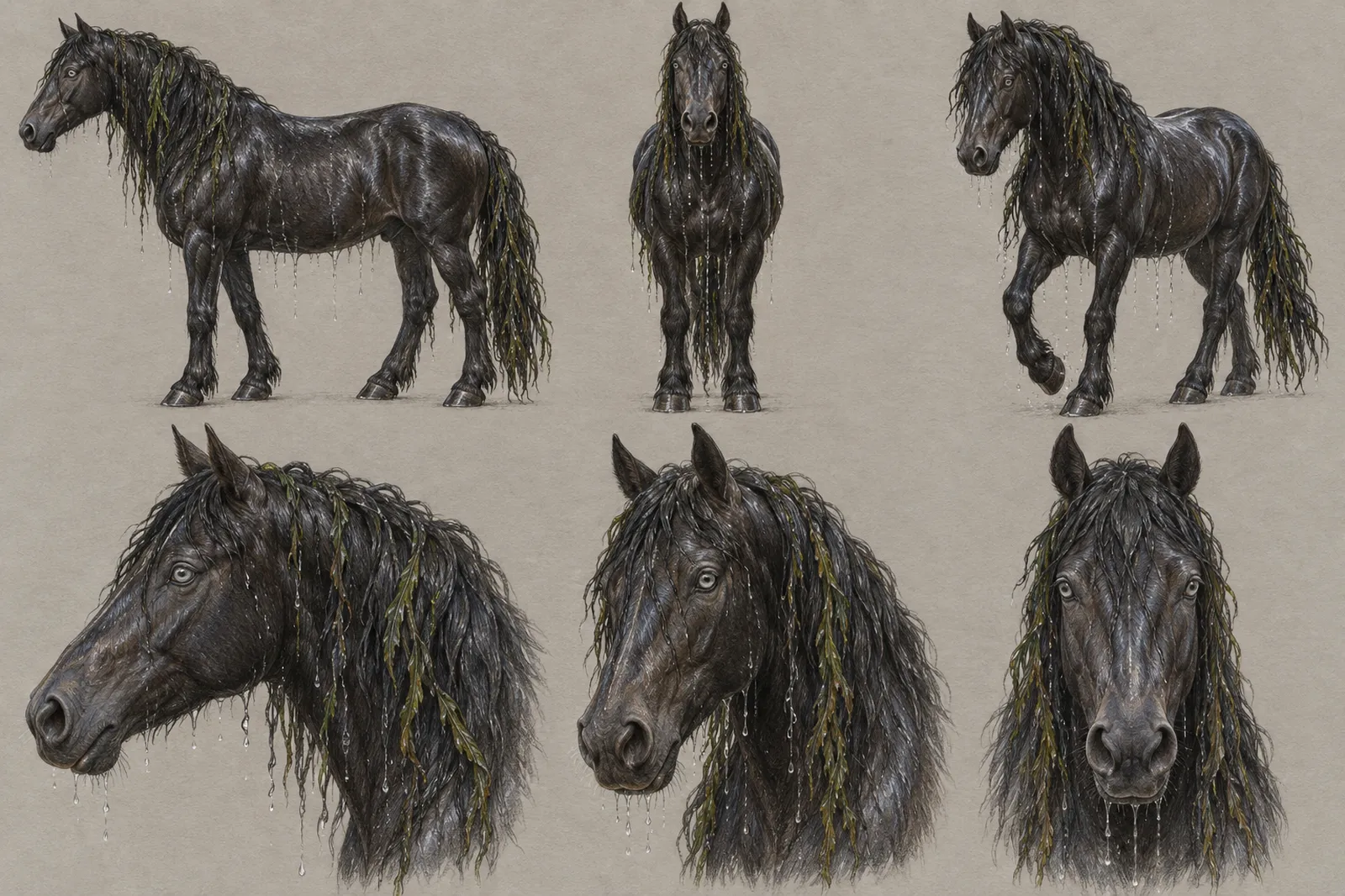
What is a kelpie?
In Scottish folklore, the kelpie is a water spirit that haunts rivers and lochs, most often in the shape of a horse. The stories agree on a few things: it looks like a fine, strong animal; it seems tame; and anyone who climbs onto its back cannot climb off again. The kelpie then runs straight into the deepest water it can find.
In the Highlands there is a close cousin, the each-uisge — Gaelic for “water horse” — said to live in lochs and sea lochs and to be even more dangerous. Some tellings give the water horse a human shape too, a handsome stranger whose hair is always wet and tangled with weed.
A story to keep children from the water
Many of the tales end the same way: children tempted onto a beautiful horse at the water’s edge, and one child who escapes to tell the others. It is easy to hear the warning underneath — stay away from deep, cold water — but the stories have outlived that purpose because they are frightening in themselves.
The bridle
The most useful thing to know about a kelpie, according to the old stories, is this: whoever holds its bridle holds its power. Take the bridle, and the water horse has to work for you, with the strength of many horses.
The best-known version is told of the Graham family of Morphie, in Angus. The laird is said to have captured a kelpie by throwing a bridle over its head and made it haul the stones for his new castle. When the work was done he let it go — and the kelpie, the story says, left a curse on the family as it went back into the water. One rhyme attached to the tale runs:
Sair back and sair banes,
Drivin’ the Laird o’ Morphie’s stanes;
The Laird o’ Morphie’ll never thrive
As lang’s the kelpy is alive.
Other parts of Scotland tell of families who kept a water horse’s bridle for generations as a treasured, slightly dangerous heirloom. In every version, the bridle is a bargain — and the bill always comes due.
Kelpies today
The legend is still visible in the Scottish landscape. Near Falkirk stand The Kelpies, two steel horse heads around thirty metres tall by the sculptor Andy Scott, completed in 2013 — among the largest equine sculptures in the world.
Our film: The Bridle
Glen Morrach, 1846. To save her blind father’s croft from eviction, Morag Fraser steals the silver bridle of a water horse that ploughs all night without tiring. The stony field is cleared in a week. Then she learns what the bridle costs.
The Bridle is coming soon. Whoever holds the bridle is held by it.